When Alright Hospital came to us in April 2025, their website had generated exactly one click from Google Search. One. Their total impressions for that month sat at five. Not five thousand. Five impressions, meaning fewer than five people had even seen their website listed anywhere in Google results.
Fifteen months later, their Search Console shows 3,210 total clicks and 197,000 impressions. They rank on Page 1 for seven competitive healthcare keywords in Nagpur. One of their pages is cited inside Google’s AI Overview for “angioplasty cost in nagpur” — a position that puts their information above every paid ad and every organic result on that search.
No paid ads were run at any point during this campaign.
This is the story of how that happened, and what it actually took.
Who Is Alright Hospital?
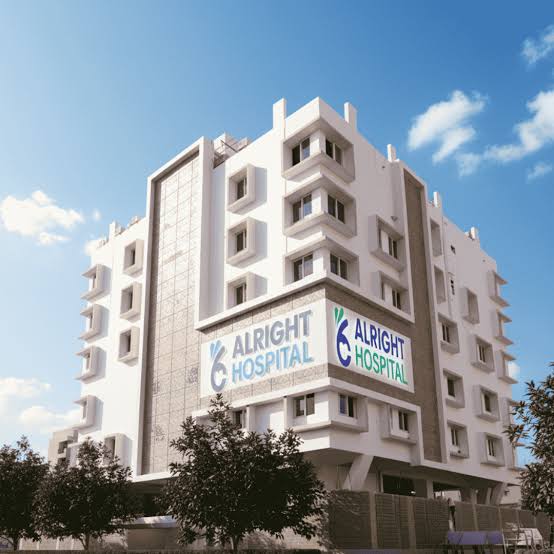
Alright Hospital is a multispeciality hospital located in Jafar Nagar, Nagpur. They offer cardiac care including angioplasty, angiography, and pacemaker implantation, along with gastroenterology, orthopaedics including knee replacement, and paediatric cardiac procedures like ASD, VSD, and PDA device closure.
They are not a small clinic. They have the specialists, the ICU, the equipment. What they did not have when we started was any meaningful presence on Google — which meant that patients in Nagpur searching for the exact services Alright Hospital offers were finding competitors instead.
Where They Started: April 2025
The Search Console data from the week we took over tells the story cleanly.
Between April 18 and April 30, 2025 — nearly two weeks — their entire website received:
- 1 total click
- 5 total impressions
- 20% CTR (high because almost no one was seeing them anyway)
- Average position: 2.8 (ranking well for their own branded name, nothing else)
That last number is the key detail. A 2.8 average position sounds strong until you realise it was calculated across five impressions. They were ranking near the top for searches of their own hospital name and essentially nowhere for anything else. A patient in Nagpur searching “best heart hospital” or “angioplasty cost” would never have found them.
The website existed. It just was not doing anything.
What We Found When We Audited the Site
Before touching anything, we ran a full technical and content audit. The problems we found are common across hospital websites in Nagpur, so I am going to be specific here because the pattern repeats.
The content was generic. The services pages said things like “We provide excellent cardiac care with a team of experienced professionals.” That is true of every hospital. Google cannot differentiate between that and the same sentence on a competitor’s website. No specific procedure descriptions. No cost information. No named doctors. No schema markup.
The site had almost no indexable text on service pages. Most of the hospital’s service descriptions were either very short, loaded inside JavaScript that Google could not read consistently, or buried behind tabs and accordions. What Google could not read, Google could not rank.
Zero local SEO infrastructure. No neighbourhood-level content, no location-specific pages, no Google Business Profile posts, and the GBP itself was only partially filled — no services listed, no photos beyond the exterior, and business description that repeated the hospital name three times in two sentences.
No procedure cost pages. This turned out to be one of the biggest missed opportunities. Patients in Nagpur search “angioplasty cost in nagpur” and “knee replacement cost in nagpur” hundreds of times per month. Nobody at Alright was capturing any of that traffic because no such page existed.
The Strategy We Built
We did not try to do everything at once. The first three months were focused on fixing the foundation. The next six months were focused on building content authority. The final six months have been about compounding and expanding.
Phase 1: Fix the Foundation (Months 1 to 3)
The technical fixes came first because content built on a broken technical base takes longer to rank and sometimes does not rank at all.
We moved every service description out of JavaScript-dependent tabs and into crawlable HTML. We added MedicalCliclinic and Physician schema markup to the homepage and to each doctor’s profile page. We compressed images that were slowing load times. We fixed duplicate title tags across eight service pages that were competing against each other for the same keyword.
Then the GBP. We rebuilt the Alright Hospital Google Business Profile from scratch — not deleting it, but completing every field that had been left empty. Primary category set to “Multispecialty Hospital.” Secondary categories added for cardiology, gastroenterology, and orthopaedics. Every service listed individually: angioplasty, angiography, pacemaker implantation, knee replacement, endoscopy, ASD device closure, and more. New photos of the ICU, the cath lab, the wards, and the doctors. Consultation hours entered for every day. The description rewritten to mention specific services and the Jafar Nagar location without keyword stuffing.
We also began the review-building process in month one. The front desk team was briefed and given a printed QR code for the reception counter. Within 60 days, the hospital had moved from under 20 reviews to over 50, with a maintained 4.5-plus average.
Phase 2: Build Content Authority (Months 4 to 9)
This is where the real work happened, and where most hospital websites never go because it requires consistent output over months before results appear.
We identified three content types that reliably drive patient searches for a multispeciality hospital:
Procedure cost pages. Patients research costs before choosing where to go. A well-structured cost page that answers the question directly — specific ranges, what affects the price, what is included — is exactly what Google wants to show for cost-intent queries.
We built individual cost pages for: angioplasty, knee replacement, angiography, pacemaker implantation, endoscopy, and ASD/VSD/PDA device closure. Each page opened with a specific cost range in the first paragraph, followed by a breakdown by procedure type, factors that affect the final price, and what to expect at Alright specifically.
Specialist pages per doctor. Every senior doctor at Alright got their own page with qualifications, areas of specialisation, conditions treated, and procedures performed. Named authorship on medical content is a direct E-E-A-T signal. Pages that have a real, credentialed doctor attached to them rank differently than anonymous clinic pages.
Comparison and educational content. Posts like “angioplasty vs bypass surgery: which is right for you” and “signs you need to see a gastroenterologist” bring in patients who are earlier in their decision-making process — people who have symptoms or concerns but have not yet chosen a hospital. This is top-of-funnel content that builds trust before the patient is ready to call.
Phase 3: Compound and Expand (Months 10 to 15)
By month nine, the core pages were ranking and generating consistent traffic. The work in this phase shifted to deepening coverage — adding new procedure pages, building internal links between related content, and keeping the GBP active with weekly posts timed to seasonal health trends.
The monsoon season in Nagpur brings predictable spikes in searches for respiratory infections, waterborne illness, and cardiac emergencies. We planned content around those windows. The “best hospital in nagpur” ranking that appears in the screenshot above was helped significantly by a “Top 5 Hospitals in Nagpur 2026” post published in May 2026 — Alright Hospital listed first, on their own domain.
That is not a hack. It is exactly what Google wants: a hospital confident enough in their quality to write that kind of content, backed by the clinical evidence and patient reviews to support it.
The Results: What 15 Months of Consistent SEO Produces
Before vs. After
| Metric | April 2025 (Start) | July 2026 (Current) | Change |
|---|---|---|---|
| Total Clicks | 1 | 3,210 | +3,209 |
| Total Impressions | 5 | 197,000 | +39,390% |
| Average Position | 2.8 (branded only) | 6.3 (hundreds of terms) | Expanded to full keyword universe |
| Page 1 Rankings | 0 (non-branded) | 7 competitive keywords | Built from zero |
| Patient Calls from GBP | Not tracked | 763 (Feb-Jul 2026) | 127 calls/month average |
The Seven Page 1 Rankings
Every ranking in the list below was verified from Google Search in July 2026 without personalisation or location bias:
| Search Query | Position | Notes |
|---|---|---|
| best hospital in nagpur | Page 1 | Organic result with image thumbnail |
| best heart hospital in nagpur | Page 1 | Position 2, behind one specialist cardiac-only hospital |
| angioplasty cost in nagpur | Page 1 | Cited in Google AI Overview |
| best gastro hospital in nagpur | Page 1 | Position 2 |
| knee replacement cost in nagpur | Page 1 | Position 2 behind Pristyn Care’s national budget page |
| pacemaker in nagpur | Page 1 | Position 2 |
| asd vsd pda in nagpur | Page 1 | Position 1 |
The AI Overview citation for “angioplasty cost in nagpur” deserves a specific mention. Google’s AI Overview pulls from sources it considers the most authoritative and clearly structured for a given query. Alright Hospital’s angioplasty cost page was written with a specific cost range in the opening sentence, a breakdown by procedure type in the body, and MedicalClinic schema on the page. That combination — clarity, specificity, schema, and a credentialed hospital as the source — is what gets a page cited in AI Overviews. It is not guaranteed by any single tactic. It is the result of every element being right at the same time.
The GBP Numbers: 763 Patient Calls in Six Months
Organic search traffic is valuable. Patient calls are what actually grow a hospital.
Between February 2026 and July 2026, Alright Hospital’s Google Business Profile generated 763 calls directly from patients finding them on Google Maps. That is an average of 127 new inbound contacts per month — consultations, emergency inquiries, appointment bookings — from patients who found the hospital through local search.
The call trend graph from GBP shows a dip in March (typical for Central India in the post-winter period when health search volume drops temporarily), followed by a consistent rise through May, June, and into July. The trend is upward and has not plateaued.
These are calls the hospital was not receiving before. Not calls we diverted from somewhere else. New patient contacts that were going to competitors because Alright was invisible.
What Actually Made the Difference
I want to be honest about this because SEO case studies tend to present a tidy narrative that makes it sound easier than it is.
The biggest single shift was the cost pages. When we published the angioplasty cost page with a specific price range in the first paragraph, it started ranking within six weeks. Patients searching “angioplasty cost in nagpur” are high-intent. They have already decided they need the procedure. They are comparing hospitals. A page that directly answers that question — with numbers, with a breakdown, with the hospital’s specific advantages — converts at a significantly higher rate than a generic services page that says “contact us for pricing.”
The second biggest shift was consistency. The GSC chart shows a flat period between May and September 2025 where the numbers barely moved. That is the part of SEO nobody talks about honestly — the three to five months where you are publishing content, fixing technical issues, and collecting reviews, and the graph looks like nothing is happening. We kept going. By October 2025, the curve started bending upward. By April 2026, it had inflected sharply. The compound effect of 10 months of consistent work showed up all at once.
The third factor was the GBP posts. We published one to two posts per week consistently, timed to seasonal health topics. Monsoon infections in July. Winter cardiac risk in December. Post-Diwali respiratory issues in November. These posts keep the GBP listing active, which Google treats as a recency signal, and they attract impressions from patients searching seasonal health topics who might not have been looking for Alright specifically.
The moment that told me the content strategy was working was when a patient called the hospital and mentioned they had found Alright’s page while searching “angioplasty cost” and had read the full cost breakdown before calling. They said — and this is a direct quote relayed by the hospital — “your website was the only one that actually told me the price.” That is what good content does. It answers the question the patient has in their head before they call. It builds trust before there is any human interaction.
A Note on What We Did Not Do
We did not buy backlinks. We did not run Google Ads to inflate traffic numbers. We did not create fake reviews or use review-gating tactics. We did not publish thin content at high volume to force rankings.
Everything in this case study is organic. The rankings are real. The calls are real. The GSC data is from a verified Search Console account.
I mention this because the Nagpur digital marketing market has a lot of agencies selling quick-result packages that involve one or more of those tactics. Some of them produce short-term movement. All of them carry risk — Google algorithm updates, GBP suspensions, manual penalties — that eventually costs the hospital more to fix than the original slow approach would have taken.
The Alright Hospital strategy took fifteen months to reach these results. That is the realistic timeline for building a strong, durable organic presence for a multispeciality hospital in a competitive city.
What Comes Next
Alright Hospital currently averages around 6.3 position across their full keyword universe. The next phase of work is focused on moving core procedure pages from position 6 to 8 up into the top three, where click-through rates increase sharply. A page at position 6 gets roughly 3 to 5% of clicks for its keyword. The same page at position 2 gets 15 to 20%.
We are also expanding coverage into specialties that currently have no dedicated content — nephrology, neurology, and the mother and child department. Each new specialty page opens a new keyword cluster. The content infrastructure built over the first fifteen months means new pages now rank faster than they did at the start because the domain has earned authority.
The curve on the GSC chart is still rising. We are not near the ceiling.
Mohammad Shahbaz leads SEO strategy at Snyptech, a digital marketing agency based in Nagpur specialising in healthcare, local SEO, and content-led organic growth. The data in this case study is sourced from verified Google Search Console and Google Business Profile accounts for Alright Hospital, Jafar Nagar, Nagpur.
All GSC and GBP data is accurate as of July 2026. Google Search ranking screenshots were captured in July 2026 without location or personalisation settings active.